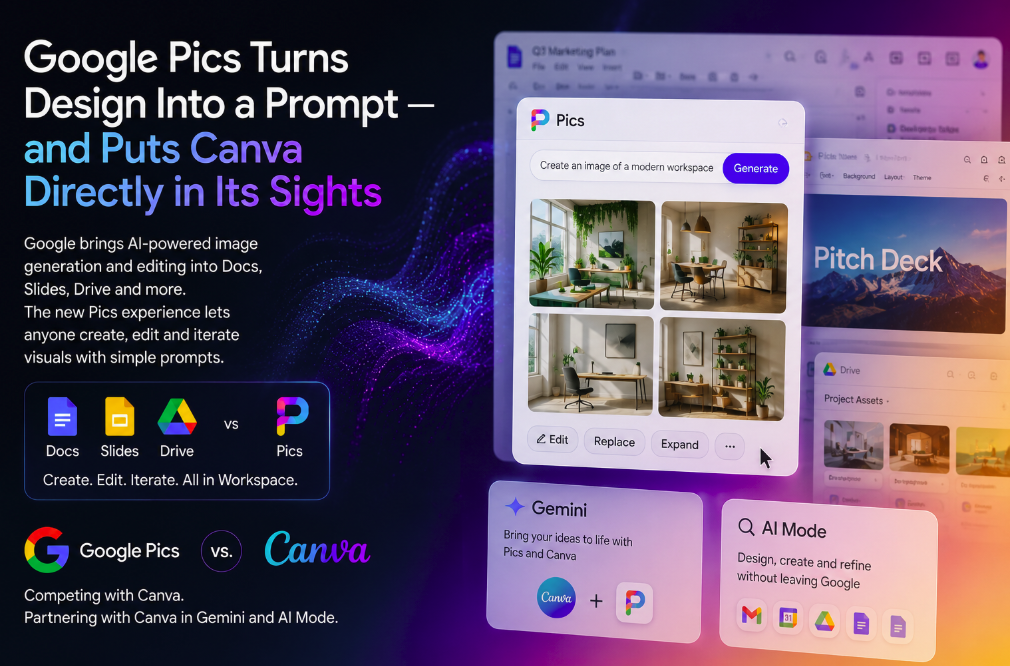
Google is turning visual design into another prompt-driven layer of Workspace. On September 1, the company began rolling out Google Pics, an AI image creation and editing application built around Gemini and its Nano Banana image models. Pics can generate a visual from a text description, but the more consequential part of the product is what happens afterward: users can select individual objects, move or transform them, rewrite or translate text inside an image, change specific regions and keep iterating without returning to a conventional graphics editor.
That puts Google much closer to the territory occupied by Canva and Adobe Express. Yet Google's relationship with Canva makes the competition unusually complicated. While Google is building its own Canva-like creative layer inside Workspace, it is simultaneously allowing Canva to operate inside Gemini and Google's AI Mode. Google is effectively competing for the design workflow while also making a major competitor available as an integrated service.
Google's launch announcement describes Pics as a tool for generating, refining and co-creating images with precise control. The product is rolling out first to eligible Google AI Pro and Ultra subscribers, while Workspace integrations extend the concept beyond a standalone application. Google says users can already move work between Pics, Docs and Slides, with deeper editing directly inside Workspace apps and Drive forming part of the broader rollout.
The important product is not Pics alone — it is Pics inside Workspace
A standalone AI image generator would enter an already crowded market. The strategic advantage Google is trying to exploit is distribution. Workspace already sits where millions of presentations, reports, marketing documents and internal communications are created. Instead of asking a user to leave a slide deck, create an asset somewhere else, export it and upload it again, Google can bring the generation and editing layer to the document itself.
The company has been moving in this direction throughout 2026. Gemini in Google Slides can already generate complete editable presentations from a prompt, use Drive files as source material and match the visual style of an existing deck. Google's June Workspace update made the direction explicit: a presentation can increasingly be assembled conversationally while remaining native and editable rather than being delivered as a static AI image.
Pics extends the same idea down to individual visual assets. Google's product page emphasizes object segmentation, allowing a user to isolate an element and then move, resize, remove or transform it. Text inside an image can be changed or translated while preserving the surrounding design. Images can also be expanded or reformatted for different dimensions. These are precisely the kinds of operations that historically forced non-designers into layers, masks, selection tools and menus.
The interface therefore matters less than the abstraction. Google is attempting to make the prompt the universal creative control: describe what should exist, then describe what should change. Manual controls remain available when precision is needed, but the user no longer has to know the sequence of editing operations required to produce the result.
This is much closer to Canva than an image generator
Comparisons with Canva are unavoidable because Pics is targeting the same broad population of people who need professional-looking visuals without becoming professional designers. The Verge described Pics as Google's Canva-like AI design tool, highlighting its ability to generate images, edit individual elements and integrate with Docs and Slides.
The competitive overlap becomes stronger as Workspace absorbs more end-to-end creative tasks. A marketing team could theoretically begin with a campaign brief in Docs, reference research stored in Drive, ask Gemini to generate a presentation, create or modify campaign artwork through Pics and collaborate on the result without leaving Google's environment. Each additional capability reduces the number of moments when a user needs to open a dedicated design platform.
That does not mean Pics already reproduces Canva. Canva has spent years building templates, brand systems, publishing workflows, printing, video tools, asset libraries and a large ecosystem around collaborative design. Pics is narrower and much newer. But generative AI changes how quickly feature boundaries can move. If users increasingly start from an instruction rather than a template, the size of the template library may matter differently than it did in the previous design-software era.
Google is competing with Canva while integrating it
The most interesting strategic wrinkle arrived from Canva itself. The company recently expanded its integration with Google Gemini and AI Mode. Through Canva's AI Connector, users can connect a Canva account to Gemini and invoke Canva from the conversation to generate designs, find existing content, edit text and images, resize assets and transform Gemini-generated images into editable layouts.
Canva is also integrated with AI Mode in Google Search. A user can research something through Google, ask AI Mode to create a design with Canva and then continue editing the resulting asset in Canva. Canva describes itself as the only connected design application announced for that AI Mode workflow.
On the surface, this looks contradictory. Google is investing in a first-party design product while providing prominent distribution to a competitor. But it is consistent with a broader platform strategy. Gemini and AI Mode become more useful when users can call the tools where their existing work already lives. Google does not need every creative task to end in Pics for Gemini to benefit from becoming the interface through which the task begins.
Canva has the inverse incentive. It cannot assume that creative work will continue to begin on Canva's homepage. If users increasingly begin projects inside ChatGPT, Gemini, Claude, Copilot, Perplexity or a search engine, Canva needs to make itself callable from those environments. Its integration with Google is part of a broader strategy that already spans several AI assistants.
The new competition is over the starting point
This reframes the Google-versus-Canva contest. Traditional software competition focused heavily on which application a user opened. Agentic and conversational interfaces create another possibility: users may stop thinking about applications until the moment they need a specialized editor.
A person could tell Gemini to prepare campaign assets from a Drive folder without initially deciding whether the final visual should be created by Pics or Canva. The assistant becomes the orchestration layer and the creative applications become tools underneath it. Whoever controls that first conversational interaction gains significant influence over which downstream service is selected.
Google is unusually well positioned because Workspace supplies context as well as distribution. Docs contains the copy, Drive contains brand files and reference material, Slides contains the destination, Gmail and Chat contain project discussions, and Gemini can increasingly work across those sources. Pics can therefore generate an image with access to the environment in which the image will actually be used.
Canva's response is to make its own design engine portable. Its connector strategy effectively says that Canva does not have to own the assistant if Canva can become the design capability assistants invoke. The two companies are consequently competing at one layer while cooperating at another.
Prompt-based design still has a precision problem
The shift does not eliminate conventional editing. Generative image systems remain unpredictable, particularly when a user needs exact brand geometry, repeatable layouts or fine control over text and objects. Google's emphasis on segmentation and direct manipulation appears designed to address precisely that weakness.
Instead of repeatedly regenerating an entire image because one element is wrong, Pics lets users operate on individual components. This hybrid model — generation followed by deterministic manipulation — is likely to be more important for professional adoption than raw image quality alone. Businesses need reproducibility and control, not merely attractive outputs.
There are also governance questions. Workspace customers may use Pics for internal documents, product imagery and marketing assets, making data handling, model behavior and brand consistency important enterprise considerations. Google is positioning the tool within its existing Workspace administration framework, with availability depending on eligible plans and administrator settings.
Design software is becoming infrastructure inside productivity suites
The larger implication is that generative AI is erasing the old border between productivity software and creative software. A document editor can generate illustrations. A presentation application can build an entire deck. A cloud drive can become the context source for new content. An AI assistant can hand a project to Canva without the user manually exporting anything.
That makes Pics strategically more significant than another entry in the AI image-generator race. Google is trying to turn Workspace into an environment where visual creation is an ambient capability rather than a separate destination. Canva, meanwhile, is trying to ensure that its design engine remains available regardless of which AI environment becomes the user's starting point.
The apparent contradiction — Google building a Canva competitor while integrating Canva — is therefore the clearest signal of where software is heading. The next platform battle may not be won by forcing users into one application. It may be won by controlling the conversation that decides which application gets used.