For years, SEO software revolved around a relatively stable set of questions: which keywords a website ranked for, where competitors appeared, who linked to them and whether technical problems were preventing Google from crawling their pages. In 2026, those questions still matter, but they no longer describe the whole discovery system. Google is generating answers inside Search, people are using conversational AI to research products and topics, and publishers increasingly need to know not only whether a page ranks but whether machines retrieve, cite or mention it.
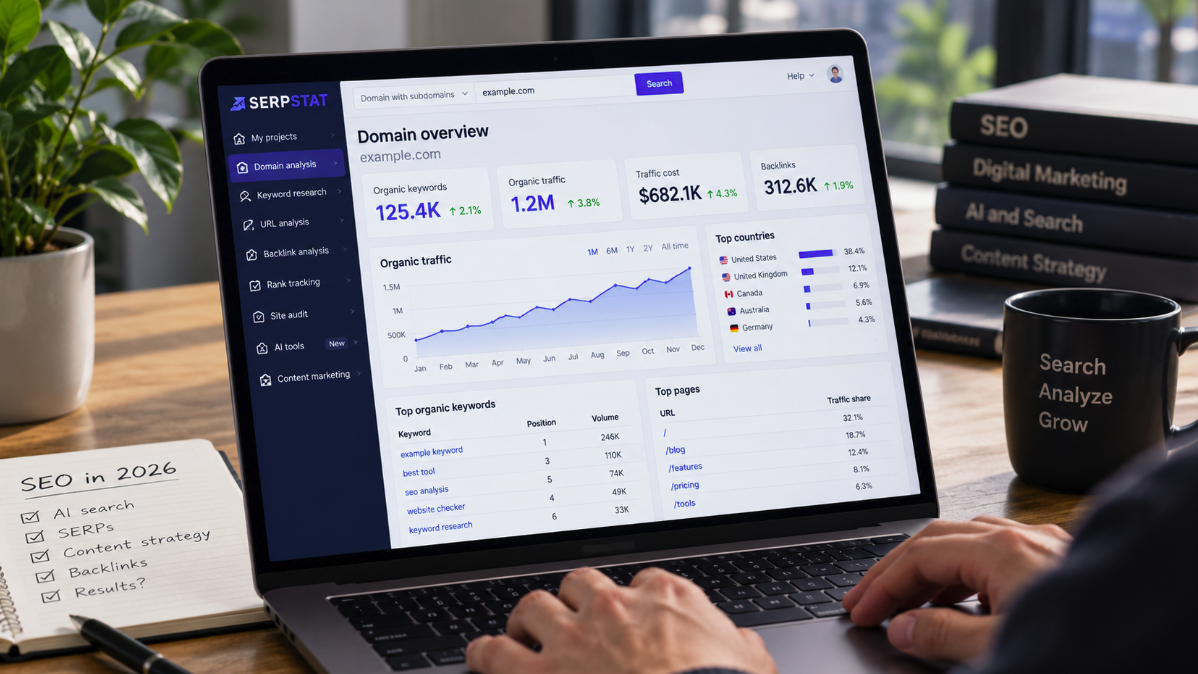
That shift is visible in the way established SEO platforms are changing. A recent hands-on NetContentSEO test of Serpstat found a product that still contains the familiar machinery of keyword research, competitor analysis, backlinks, rank tracking and technical audits, but is increasingly adding AI-search measurement to the same workflow. Serpstat is not alone in moving this direction, but its evolution illustrates a larger change: SEO software is being forced to redefine what “visibility” means.
Google itself now treats generative search as a measurable channel
The clearest evidence that this is more than an SEO-industry rebranding exercise comes from Google. In June 2026, Google announced dedicated generative-AI performance reports in Search Console, giving website owners separate visibility into impressions generated through features such as AI Overviews and AI Mode. Google said on August 31 that the insights had rolled out to websites worldwide.
That creates an important distinction. Generative search is not replacing the underlying web index: Google says its AI experiences still depend on core Search ranking and quality systems, including retrieval of relevant pages from its index. Its 2026 guidance for generative AI features explicitly says conventional SEO remains relevant. Pages still need to be accessible, indexable, useful and technically sound before they can become useful sources for AI-generated answers.
But the user experience above that index is changing. AI Overviews can synthesize information from multiple sources, while AI Mode can fan a question out into related searches and construct a response with supporting links. A publisher can therefore participate in the answer without occupying the conventional position that SEO teams historically monitored.
The old ranking-to-click equation is becoming less reliable
This matters because search visibility has traditionally been valuable largely as a route to a click. Research from the Pew Research Center showed how AI summaries can disrupt that relationship. In its analysis of U.S. browsing data from March 2025, users clicked a traditional search result in 8% of visits where an AI summary appeared, compared with 15% when one did not. A link directly inside the AI summary was clicked in only 1% of visits containing a summary.
The study covered an earlier stage of Google's AI rollout and should not be treated as a permanent forecast of search behavior. Even so, it demonstrates why an SEO dashboard built only around rankings and estimated traffic can miss part of the story. A site might gain exposure as a cited source without receiving a conventional click, while another might retain a strong organic position but lose attention because an AI-generated answer satisfies the query first.
Google disputes the idea that AI search simply destroys the value of publisher traffic. The company says clicks from pages containing AI Overviews can be higher quality and that AI features can expose users to a wider range of sources. Both things can be true at once: fewer clicks on some queries and more qualified visitors on others. The measurement problem is determining which pattern applies to a particular site.
Serpstat is trying to connect those two measurement worlds
Serpstat's current product still looks recognizably like an all-in-one SEO suite. Its plans include domain and keyword analysis, backlink research, rank tracking and site auditing. The company also advertises AI Overview keyword tracking, an AI Overview Brand Opportunities report and integrations that allow Serpstat data to be queried from ChatGPT and Claude through its higher-tier plans.
More significant than simply adding an “AI” tab is the data layer Serpstat is building around generated search results. The company says its AI Overview dataset contains more than 250 million records across over 180 regions, with source URLs, domains and inline citations. Serpstat also says its analysis of 35 million AI Overviews found that most cited sources did not rank in the organic top 20 for the corresponding query. That is a company-produced dataset rather than independent research, so the exact percentages should be interpreted accordingly, but the underlying analytical question is important: AI citation and conventional ranking may overlap less neatly than many SEO teams assume.
A short product test cannot establish whether using those tools increases traffic or AI citations. NetContentSEO explicitly limited its conclusion after receiving 15 days of temporary access, arguing that a real performance experiment would require a baseline, documented changes and repeated measurements over weeks or months. That restraint is useful because the market is currently full of products claiming to optimize “GEO,” “AEO” or LLM visibility without a universally accepted measurement standard.
AI visibility is harder to measure than a SERP
A conventional rank tracker has a comparatively clear observation: a specific URL appeared in a specific position for a query, device, location and time. Generative systems introduce more variables. A brand can be mentioned without a link. A page can be used as a source without receiving prominent attribution. Different models can answer the same prompt differently, and the same system can produce a different answer on another run.
That means any credible AI-visibility metric needs context. Which model was tested? Which prompts were used? How were those prompts selected? How frequently were they repeated? Was the website cited, merely mentioned, or recommended? Did a citation survive across repeated runs? Without those details, a single “AI visibility score” risks compressing several distinct phenomena into a number that looks more precise than it really is.
This is where traditional SEO tools may have an advantage over entirely new AI-monitoring products. They already contain years of data about domains, queries, backlinks, pages and competitors. If AI citations can be layered onto that existing evidence, teams can investigate relationships instead of treating generative visibility as an isolated metric. A page that suddenly appears in AI Overviews can be examined alongside its indexing status, backlinks, topical coverage and conventional rankings.
The boring parts of SEO survived the AI transition
Perhaps the most consequential message from Google's own documentation is that there is no special technical shortcut for appearing in its generative features. Google says a page must be indexed and eligible to appear in Search with a snippet, and that there is no additional AI-specific schema or machine-readable file required. Crawling, internal links, useful text, page experience and accurate structured data remain relevant.
That makes the industry's obsession with renaming SEO somewhat misleading. Generative search adds a new retrieval and presentation layer, but it does not make canonical tags, crawlability, content quality or site architecture disappear. A publisher with an inaccessible page does not gain an advantage by calling its strategy GEO. A technically healthy site with distinctive information, meanwhile, is building assets that can potentially surface in both traditional and generative results.
Google reinforced that point in May when it published new generative-search optimization guidance specifically addressing misconceptions around AEO and GEO. The company continues to emphasize unique, useful, non-commodity content rather than a separate recipe for AI systems.
The next SEO platform will look more like an investigation console
This leaves SEO software with a more difficult job than it had five years ago. Rank tracking remains useful, but it must coexist with AI citations. Keyword research remains useful, but search volume alone says less about the traffic a query may produce. Backlinks remain evidence of authority, while technical audits remain necessary to ensure that content can enter the systems doing the retrieval in the first place.
The winning tools may therefore be the ones that resist offering one definitive metric. Search is becoming a collection of overlapping discovery surfaces, each with different rules and different user behavior. The practical task is to connect enough evidence to diagnose why a page or brand is visible in one surface and absent from another.
Serpstat's expansion into AI-search data is one example of that transition rather than proof that the measurement problem has been solved. The more important development is that the category itself is changing. SEO software used to tell teams where they ranked. Increasingly, it will have to explain where information is being retrieved, synthesized and cited—and how those new forms of visibility relate to the web infrastructure underneath them.