Search was never just retrieval.
It was a contract.
A fragile exchange between the web and the machine:
-
publishers created
-
engines indexed
-
users discovered
-
traffic returned
-
meaning circulated
For decades, that loop held.
Not because it was fair.
But because it was legible.
Now, the loop is dissolving.
And a new rumor makes that dissolution visible.
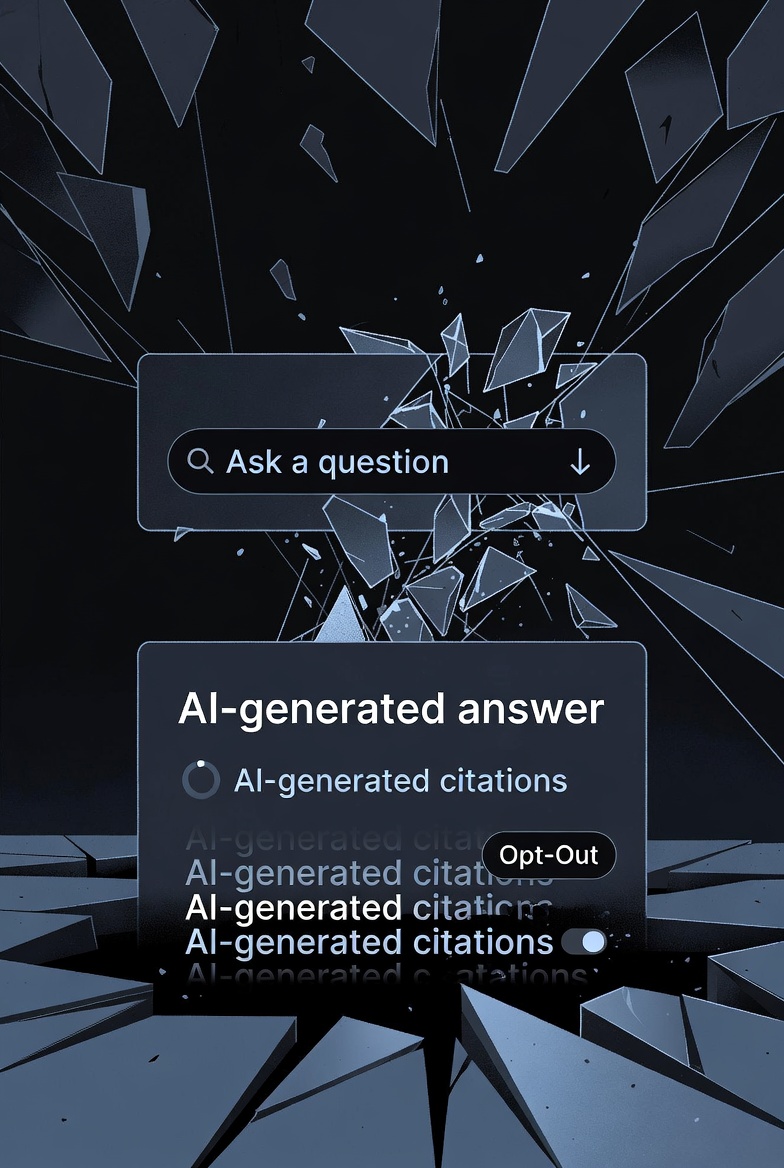
Google is reportedly exploring controls that would allow publishers to opt out of generative features such as AI Overviews and AI Mode.
A simple toggle, on paper.
But structurally, something else.
Opt-Out Is Not a Preference
In a generative system, nothing is neutral.
To “opt out” is not to disable a feature.
It is to ask a deeper question:
Do I still exist as a source, or only as training data?
Because AI Overviews do not rank pages.
They absorb them.
They do not point outward.
They speak inward.
The web becomes background.
The interface becomes answer.
The Contract Is Breaking
Google itself has said that any control must avoid disrupting Search or creating fragmentation.
That sentence is revealing.
Because it admits something quietly:
Search is no longer a list.
It is becoming an interpretation layer.
And interpretation cannot easily be partitioned.
So the real question is not:
-
“Can publishers opt out?”
The real question is:
-
“Can publishers remain visible without being consumed?”
Visibility Without Return Is Extraction
The old SEO paradigm was competitive.
But it was transactional.
You gave content.
You received attention.
Generative search introduces a new asymmetry:
-
the system speaks
-
the source disappears
-
attribution becomes optional
-
traffic becomes incidental
This is not optimization.
It is ontological drift.
The source is no longer a destination.
It is a component.
Citability Is the New Existence
In the generative era, ranking is not the only axis.
The deeper axis is recognition.
Not:
-
“Am I first?”
But:
-
“Am I still cited as real?”
A site that is not cited is not absent.
It is worse:
It is metabolized.
This is why opt-out matters.
Not because publishers want control.
But because systems require boundaries to remain intelligible.
Opt-Out Is a Symptom, Not a Solution
If Google introduces such a mechanism, it will not be the end of the problem.
It will be the beginning of an admission:
Generative search cannot survive as a closed monologue.
It must remain accountable to origins.
Otherwise, the open web collapses into silent infrastructure.
A knowledge substrate with no authors.
A library with no names.
The Future of Search Is Not Ranking
It is not even traffic.
The future of search is epistemic.
It is about:
-
who is allowed to be a source
-
who is recognized as origin
-
who remains legible inside synthesis
Opt-out is not a switch.
It is a fracture line.
A sign that Search is becoming something else.
And that the web is starting to notice.
As Stefano Galloni recently noted in his editorial analysis, the question is no longer whether pages rank — but whether sources remain visible as origins inside generative synthesis. The original reflection is available on his blog.galloni.net
❓ FAQ
1. Is Google really offering an AI opt-out?
Not yet. Only an exploration. But the signal is structural: governance is entering the generative layer.
2. Why does opt-out matter beyond SEO?
Because it defines whether publishers remain sources or become raw material.
3. What replaces rankings in generative search?
Citability. Recognition. Attribution. The right to remain an origin.