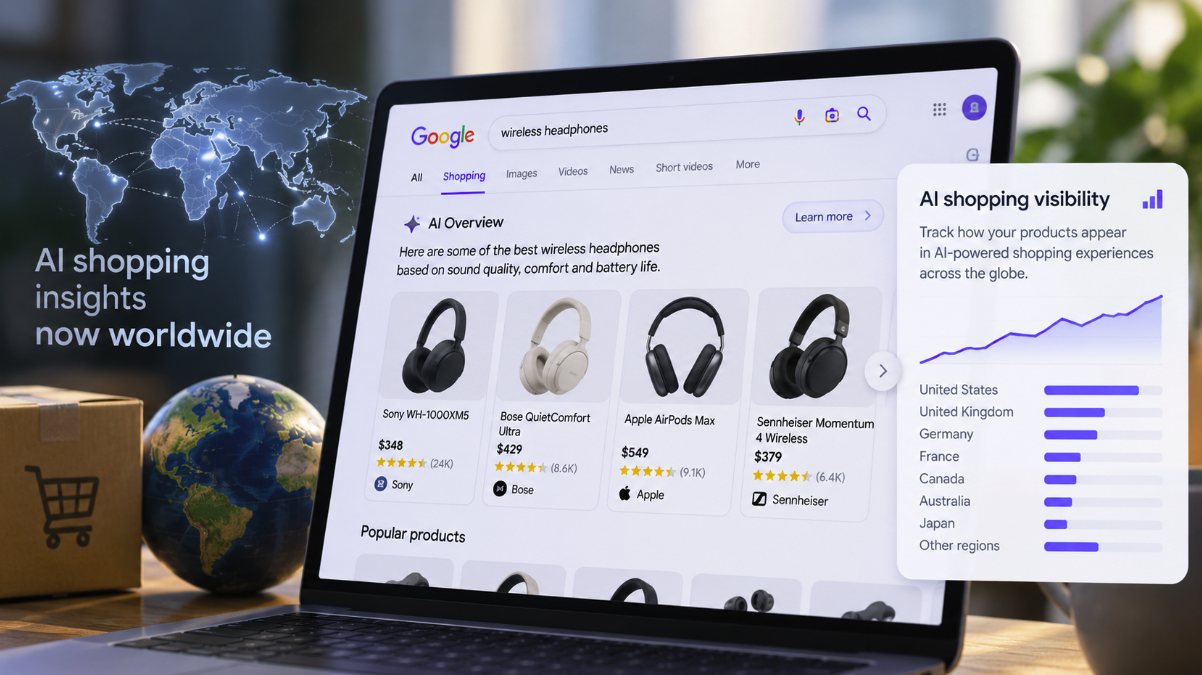
Retailers have spent the generative-search era with an awkward measurement problem: a product can be considered, compared or recommended inside an AI-generated shopping conversation without producing the familiar ranking and click trail that ecommerce teams use to measure search performance. Google is now making more of that activity visible. Its AI Performance Insights in Merchant Center are available for English-language queries in Australia, Canada, India, New Zealand and the United States, extending a reporting layer built specifically around shopping journeys in AI Mode and AI Overviews.
NetContentSEO highlighted the international expansion on September 3, after Google updated the availability information for the feature. The geographic expansion is still limited rather than global, but the larger change is more consequential: Google is beginning to formalize “AI visibility” as something merchants can measure inside the same ecosystem where they already manage product data.
That matters because optimization tends to change once a platform supplies a metric. Until now, brands trying to understand whether they appeared in generative shopping results often relied on manual prompting, third-party monitoring tools or anecdotal testing. Merchant Center can now expose Google's own view of which brands and products surface for conversational shopping intent. AI shopping optimization is starting to move from experimentation toward an analytics discipline.
Google is measuring whether a brand enters the AI conversation
Google's current Merchant Center documentation says AI Performance Insights are designed to show how brands are discovered for shopping-intent conversational queries across AI Mode and AI Overviews. The report organizes that visibility around metrics and dimensions that are notably different from a conventional list of search rankings.
One of the most important is share of voice. Google compares a merchant's AI impressions with impressions generated by that merchant and a set of competitors for related queries. Merchants can then see whether their relative visibility is above or below an average for the comparison group.
This introduces a measurement layer before the click. Conventional ecommerce analytics are good at showing what happens after a product receives exposure: impressions, clicks, product-page visits, add-to-cart events and conversions. Conversational AI creates situations in which a product may never reach that stage because the system has already narrowed the available choices. Share of voice attempts to answer the earlier question: was the brand surfaced in the AI-mediated discovery process at all?
Google also exposes metrics such as frequency and the number of products showing for selected terms, attributes and intents. Those dimensions can help merchants distinguish weak demand from weak representation. If consumers frequently express an intent involving a particular product characteristic but few items from a merchant appear, the problem may lie in catalog coverage or product data rather than consumer interest.
The shopping funnel is becoming conversational
AI Performance Insights divides shopping activity into discovery, evaluation and ready-to-buy stages. The model is familiar to marketers, but applying it to conversational search is significant because a single interaction can compress several traditional search sessions into one exchange.
A shopper might begin by asking what kind of running shoe suits a particular training routine, continue by comparing cushioning materials and weight, specify a budget and then ask which product to buy. In conventional search analytics, those steps might generate multiple queries and result pages. In an AI interface, they can become turns in the same conversation.
Google's report therefore surfaces popular terms, attributes and search intents alongside funnel-stage visibility. For ecommerce teams, this can reveal not only which products appear but the language consumers use when describing their needs. That language can be considerably richer than the short keyword strings around which traditional product SEO developed.
The change does not make conventional search data obsolete. Instead, it adds another representation of demand. Keywords remain useful signals, while conversational intent can expose combinations of use case, specification, context and preference that were previously difficult to aggregate.
Product feeds are becoming an AI knowledge layer
The practical implication is that Merchant Center data is no longer only a feed for Shopping surfaces. It is increasingly part of the structured evidence Google's systems can use to understand what a product is and whether it matches a complex request.
Google recommends maintaining accurate, current product information and improving titles, descriptions and attributes based on the terms and specifications revealed by AI Performance Insights. The logic is straightforward. If a consumer asks for a waterproof jacket made from a particular material, available in a certain color and suitable for a particular activity, an AI system needs reliable evidence connecting products to those constraints.
Missing structured attributes can therefore become an AI visibility problem. A retailer may sell the right product but describe it inadequately for machine retrieval. That pushes ecommerce SEO, merchandising and feed management closer together: titles, descriptions, categories, availability and product attributes collectively form a machine-readable description of the catalog.
This direction is also visible in Google's broader Merchant Center changes. Its 2026 product-data specification update introduced additional structured fields, including an optional product video link and new shipping-related attributes. Not every field is directly tied to AI Performance Insights, but the trend is consistent: richer product data gives Google more structured material with which to represent products across increasingly diverse surfaces.
AI share of voice is useful — and easy to overinterpret
The new report should not be treated as a universal score for a brand's AI presence. Google's documentation currently limits availability to English-language queries for eligible Merchant Center accounts in five countries. It also focuses on Google's own generative shopping ecosystem rather than answering how a product performs across ChatGPT, Claude, Perplexity or other AI services.
There are important methodological caveats inside the report itself. Google defines the competitor set available to merchants rather than allowing them to select any competitor manually. Accounts with insufficient comparison data can display unusual results, including a 100 percent share of voice that does not necessarily mean a brand dominates its market.
The data also has reporting latency, making it better suited to identifying trends than monitoring AI exposure in real time. And visibility is not equivalent to commercial performance. A product appearing frequently in AI results can still have weak pricing, low conversion, poor availability or limited customer demand.
This distinction matters because a new metric quickly creates incentives to optimize for the metric itself. Ecommerce teams should resist treating AI share of voice as the equivalent of revenue. Its strongest use is diagnostic: showing where a brand appears, where it is absent and which conversational themes or product attributes may explain the difference.
Google is defining the analytics vocabulary for AI commerce
The strategic consequence extends beyond Merchant Center. Platforms gain influence over markets partly by defining what participants measure. Search engines normalized rankings, impressions and click-through rates. Advertising platforms built businesses around cost per click, return on ad spend and conversion attribution. AI commerce now needs its own measurement vocabulary.
Google is proposing one: AI impressions, share of voice, conversational intent, products showing and visibility across shopping stages. If retailers adopt those concepts in dashboards, agency reports and optimization workflows, Google's interpretation of AI shopping performance can become an industry reference point.
That could also create demand for independent measurement. A retailer increasingly needs to know not merely whether Google surfaces its products, but how visibility differs between AI Mode, ChatGPT and other assistants, whether the same competitors dominate each platform and whether improved structured data changes recommendations consistently. Google's report provides unusually valuable first-party information, but it covers only the portion of conversational commerce that Google itself can observe.
The development also complicates the emerging field often described as GEO, AEO or AI-search optimization. For ecommerce, the problem is becoming more concrete than trying to make a brand “mentionable” by a language model. Merchants have structured catalogs, prices, inventory, specifications and transaction intent. Google's reporting suggests that optimization can increasingly be tied to specific gaps between what shoppers ask for and what product data allows an AI system to retrieve confidently.
The black box is becoming measurable, but only partly
When Google first announced AI Performance Insights in May, it said the feature would help brands understand product discovery across AI Mode, AI Overviews and the Gemini app, with rollout planned for the United States, Canada, Australia, India and New Zealand. The current dedicated documentation confirms availability in those five markets for English-language queries and describes the reporting around AI Mode and AI Overviews.
That is a relatively small geographic footprint compared with Merchant Center's global reach. It nevertheless establishes a direction that matters well beyond those markets. Generative shopping is being incorporated into ordinary merchant analytics rather than treated as a separate experimental channel.
For retailers, that changes the question. The debate is no longer only whether AI systems influence product discovery; Google is now exposing metrics specifically designed to quantify that influence. The next challenge is learning what those numbers actually predict.
If AI share of voice eventually correlates with sales, brand demand or customer acquisition, it could become a standard ecommerce KPI. If it proves volatile or weakly connected to commercial outcomes, merchants may treat it primarily as an upper-funnel diagnostic. Either way, Google's expansion is an important threshold: product visibility inside generative search is no longer entirely invisible, and that means the competition to optimize it can become much more systematic.