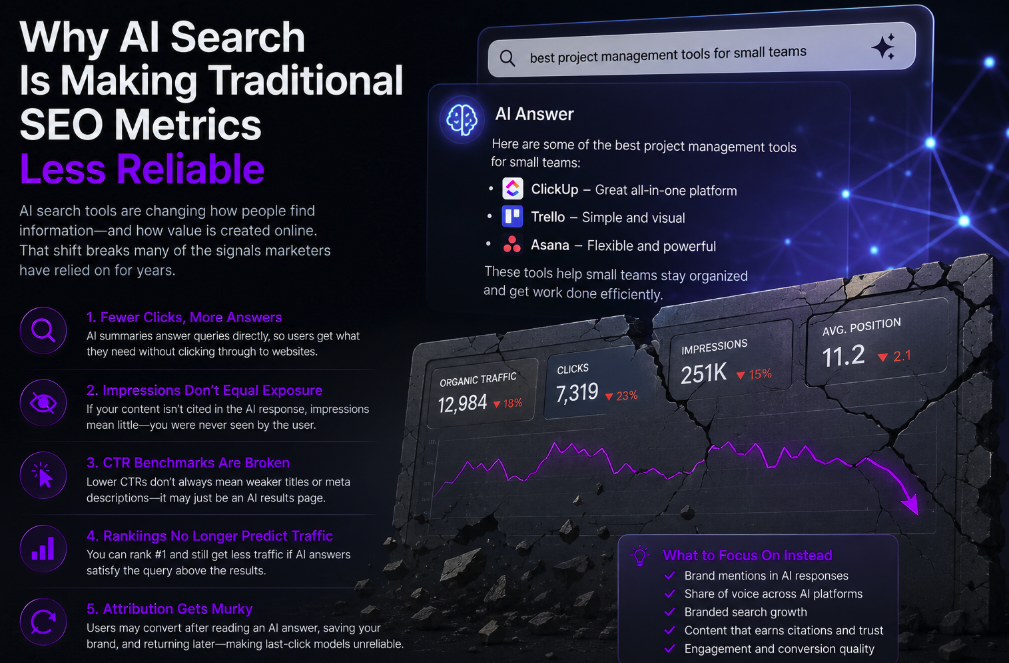
For two decades, search optimization was measured through a relatively understandable funnel: a page ranked for a query, the ranking generated an impression, some impressions became clicks, and those visits could eventually become conversions. AI-generated search results are weakening that chain. A website can now contribute information to an answer, influence a user’s decision or reinforce a brand without receiving the click that conventional analytics were built to measure.
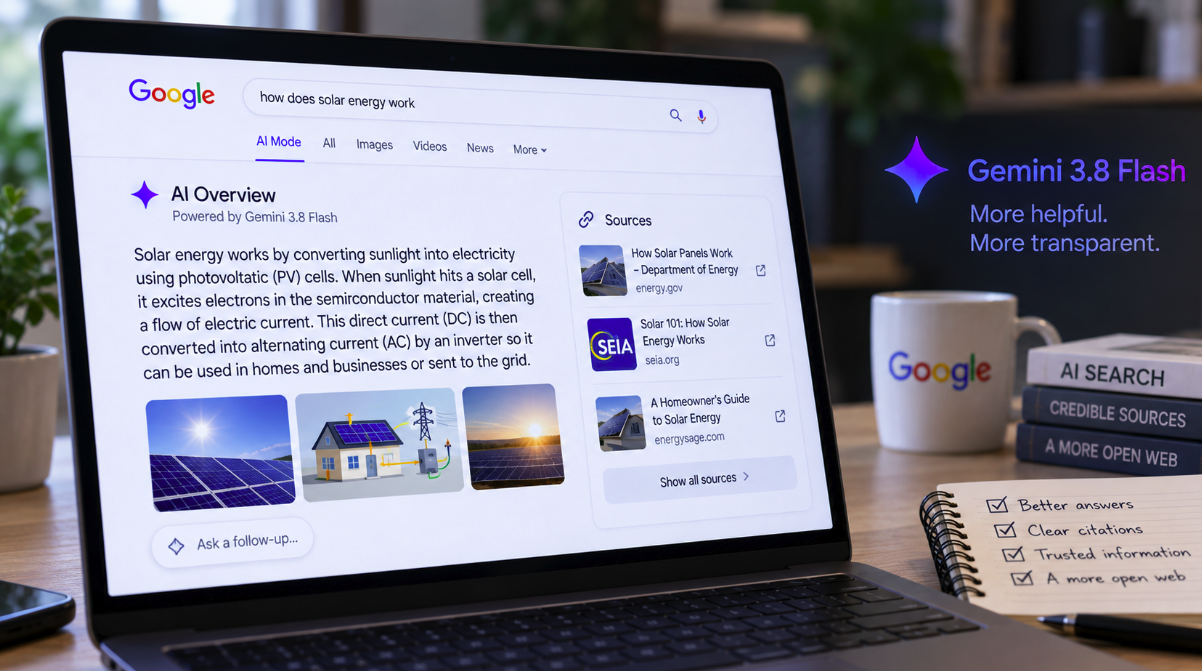
This does not make SEO obsolete. Google itself says the same foundational SEO practices remain relevant to AI Overviews and AI Mode, and pages generally need to be indexed and eligible for conventional Search snippets to appear as supporting links in those experiences. But AI search is changing what familiar metrics mean. Rankings, click-through rates and organic sessions increasingly describe only part of a site’s search visibility rather than the entire outcome.
A high ranking no longer guarantees the same opportunity for a click
The clearest evidence comes from user behavior around AI summaries. A Pew Research Center analysis of Google browsing behavior found that users clicked a traditional search result in 8% of visits where an AI summary appeared, compared with 15% of visits without one. Links contained directly in AI summaries were clicked in only 1% of visits to pages containing those summaries.
The study does not prove that every site will lose the same proportion of traffic, and search behavior varies substantially by query. It does show why ranking position can no longer be interpreted using historical click-through assumptions without considering the search interface surrounding it. A page might retain a strong organic position while an AI-generated answer resolves enough of the user’s question that no click follows.
Pew also found that 26% of visits involving an AI summary were followed by the user ending the browsing session, versus 16% for pages without an AI summary. In other words, the search engine can increasingly become the destination rather than merely the directory.
Impressions and visits are separating from influence
Traditional analytics are strongest when a user moves from a search engine to a website. AI answers introduce another outcome: the user may encounter a publisher, product or brand inside a synthesized response without ever visiting the source.
That creates an attribution problem. Suppose an AI assistant recommends a software product after synthesizing information from reviews, documentation and community discussions. The user remembers the product, later searches its name and converts through a branded query or direct visit. Standard analytics may credit the final interaction even though the AI answer played an important role in discovery.
The reverse problem exists too. A publisher can be cited prominently in an AI response and receive surprisingly little referral traffic. Research from Cloudflare has documented a widening gap between the amount of content AI systems crawl and the traffic they refer back to websites. Its 2025 analysis also observed declining Google referrals among a cohort of news sites as AI-driven search features expanded, while noting that several factors can affect referral trends.
This weakens the old assumption that visibility and traffic should move together. In an AI-mediated discovery environment, influence can happen upstream of the measurable session.
CTR is becoming a property of the whole results page
Click-through rate has traditionally been useful partly because it helped diagnose individual search listings. A strong position with unusually low CTR might suggest an unappealing title, a weak description or a mismatch between the page and the query.
That interpretation is becoming less reliable. A low CTR can now result from the interface answering the question before the user reaches the listing. AI summaries, conventional featured snippets, video modules, maps, shopping features and other rich results all compete for attention, but generative answers can occupy especially large amounts of the results experience and can synthesize information from multiple sources at once.
The effect is particularly relevant to informational queries. Pew found that AI summaries appeared much more frequently for longer and question-like searches in its dataset: 60% of searches beginning with question words such as “who,” “what,” “when” or “why” generated an AI summary. These are precisely the kinds of queries around which publishers have historically built explanatory SEO content.
AI visibility is measurable, but measurement is still fragmented
The analytics industry is already adapting. In June 2026, Google announced dedicated Search Generative AI performance reports in Search Console, initially rolling them out to a subset of websites. The reports provide separate views of impressions within generative AI features including AI Overviews and AI Mode.
The move is significant because it acknowledges that generative-search visibility deserves its own analytical lens. Google’s documentation continues to emphasize that standard SEO fundamentals apply to its AI features, but separating generative impressions can help site owners understand when traditional performance data is being shaped by a different type of search experience.
Outside Google, measurement is harder. ChatGPT, Perplexity, Gemini, Copilot and other AI products do not provide publishers with one standardized equivalent of Search Console. Referral traffic can be measured when attribution information survives the journey, but a brand mention without a click leaves no conventional website session to analyze. Different AI systems can also produce different answers, citations and recommendations for variations of the same prompt.
Rank tracking is shifting toward answer tracking
Traditional SEO asks where a URL ranks. AI search adds a second question: whether the site, source or brand appears in the generated answer at all.
Those are related but not identical forms of visibility. An Ahrefs analysis of 1.9 million citations from one million AI Overviews found substantial overlap between conventional rankings and AI citations, suggesting that classic search visibility still matters. But the existence of overlap does not mean the outputs are interchangeable. Generative systems can select, combine and present sources differently from a ten-blue-links ranking.
This means marketers increasingly need to observe prompts and topics rather than only keywords and positions. Useful questions include whether a brand is mentioned for commercially important topics, whether its own pages are cited, which third-party sources influence the answer, and whether the system describes the company accurately. These are closer to share-of-voice and reputation measurements than conventional rank tracking.
AI referral traffic is small, but that can be misleading
It would be a mistake to conclude that AI assistants have already replaced search engines as traffic sources. An Ahrefs study of roughly 35,000 websites in 2025 estimated that AI assistants represented only about 0.1% of total referral traffic in its sample. Search remained vastly larger.
Yet referral share measures only clicks that arrive at a website. It does not capture zero-click AI exposure, citations without visits or users who discover a brand in an assistant and return through another channel. That is exactly why conventional traffic metrics can underestimate AI’s role even while correctly showing that direct AI referrals remain comparatively small.
Conversion data can be similarly uneven. Ahrefs separately reported that, on its own website, AI-search visitors represented a tiny share of visitors but produced a disproportionately large share of signups. That is one company’s experience rather than a universal benchmark, and broader studies have found mixed engagement patterns for AI referrals. The useful lesson is not that AI traffic always converts better; it is that volume alone is insufficient to evaluate the channel.
SEO needs a wider measurement model
Rankings, impressions, CTR, backlinks and organic sessions are not suddenly useless. They remain important indicators of discoverability, site health and demand. The problem is treating them as complete proxies for search influence when more discovery happens inside generated answers.
A more resilient measurement model combines conventional SEO metrics with AI-era signals: visibility and citations in generative results, brand mentions across assistants, branded-search trends, direct traffic, conversion quality and the third-party sources that AI systems repeatedly use when discussing a topic. None of these measures is perfect individually, but together they can reveal influence that a click-only model misses.
The strategic implication is also broader than “optimize for AI.” Google’s guidance for AI features continues to recommend the fundamentals familiar from ordinary search: technically accessible pages and helpful, reliable, people-first content. AI systems still need useful information to retrieve, synthesize and cite.
What is changing is the feedback loop. The web’s traditional bargain connected crawling, ranking and visibility to referral traffic closely enough that clicks became the dominant performance currency. AI search is loosening that connection. The next generation of SEO measurement will have to answer a harder question than “How many people clicked?” It will need to determine how often a source shaped the answer even when the user never left the search interface.