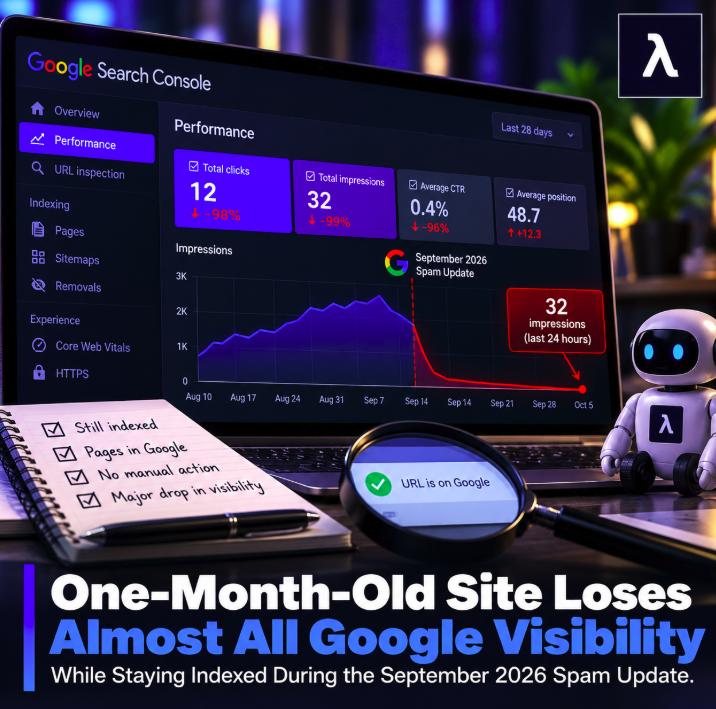
A newly launched website has reported an extreme Google visibility collapse while its pages remain indexed, creating a useful case study in the difference between index inclusion and search retrieval.
The case involves a Hong Kong telecom comparison website launched around September 6, 2026. According to Search Console figures shared by its owner, the site initially grew to roughly 2,500–3,000 impressions per day. By October 7, the latest 24-hour report showed only 32 impressions.
The original case was published on Reddit's r/DoSEO and was subsequently analyzed by NetContentSEO. NetContentSEO's analysis
The pages did not disappear from Google
The most interesting signal is what apparently did not happen. The site owner reported no manual action, no security issue and no obvious robots or noindex problem. Pages continued to appear as indexed.
This makes the case fundamentally different from a straightforward deindexing event. Google can retain a URL in its index while dramatically reducing the queries for which that URL is retrieved or the position at which it appears.
Visibility fell while average rankings deteriorated
The site's reported 28-day totals included approximately 57,900 impressions and 679 clicks, with an average position near 10.3.
During the collapse, impressions fell almost to zero and the latest 24-hour average position reportedly deteriorated to around 32.
That combination points toward a broad loss of search visibility rather than a tracking anomaly affecting clicks alone.
The timing overlaps the September 2026 spam update
The decline occurred while Google's September 2026 spam update was rolling out.
That timing is notable but does not establish causation. There is no site-specific Google confirmation that the spam update affected this domain, and the owner reported no manual action.
An algorithmic reassessment is therefore one hypothesis among several, not a confirmed diagnosis.
Thousands of location pages are an important variable
The site's architecture adds another dimension to the case. It reportedly contains several thousand pages representing real residential estates in Hong Kong, with broadband and mobile-plan information organized by location.
The business rationale is legitimate: telecom availability can vary geographically. But the owner also acknowledged substantial template reuse and overlapping provider information between locations.
This creates an important quality question. Real locations do not automatically make every generated location URL independently valuable.
Scale changes the quality threshold
A single page with partially repetitive information may not be remarkable. Thousands of pages built from the same structure can produce a very different site-level footprint.
The key question is whether each location page contains information that materially helps a user make a location-specific decision.
If most of the useful content is identical and only the geographic identifier changes, Google may have little reason to retrieve every page independently even if it continues indexing them.
Indexing and ranking should be modeled separately
This case is a useful reminder for anyone studying search systems: indexing is not ranking.
An index answers whether a document is available to the retrieval system. Ranking determines whether that document is selected for a query and where it appears relative to competing documents.
A page can therefore pass the indexing stage and still receive almost no exposure.
New domains create additional uncertainty
The website was only about one month old when the collapse occurred. That means its earlier performance represents a very short observation window.
New sites can experience substantial volatility while search systems gather more information about their content, architecture, duplication patterns, usefulness and external signals.
It would therefore be risky to treat the site's first few weeks of rankings as an established baseline from which Google permanently removed visibility.
What should be measured next?
The most useful next step is not to rewrite thousands of pages immediately. It is to segment the loss.
Researchers should compare location pages with provider pages, editorial pages and higher-level comparison pages. They should examine which directories lost queries, whether some page types retained visibility and whether pages with more unique local data performed differently from near-template equivalents.
Crawl logs, canonical selection, sitemap behavior, internal linking and server responses should also be checked before attributing the decline entirely to content quality.
The LMBDA takeaway
This is an anecdotal case, not proof of a new Google rule. But it illustrates an important search-system principle extremely clearly.
A document can remain in Google's index while effectively disappearing from search discovery.
For scaled sites, the research question is therefore not simply whether Google indexed the URLs. It is whether the retrieval system continues to find each document sufficiently distinct and useful to surface for real queries.
The distinction between stored, eligible and actually retrieved is becoming increasingly important not only for traditional search engines, but also for AI retrieval and citation systems.