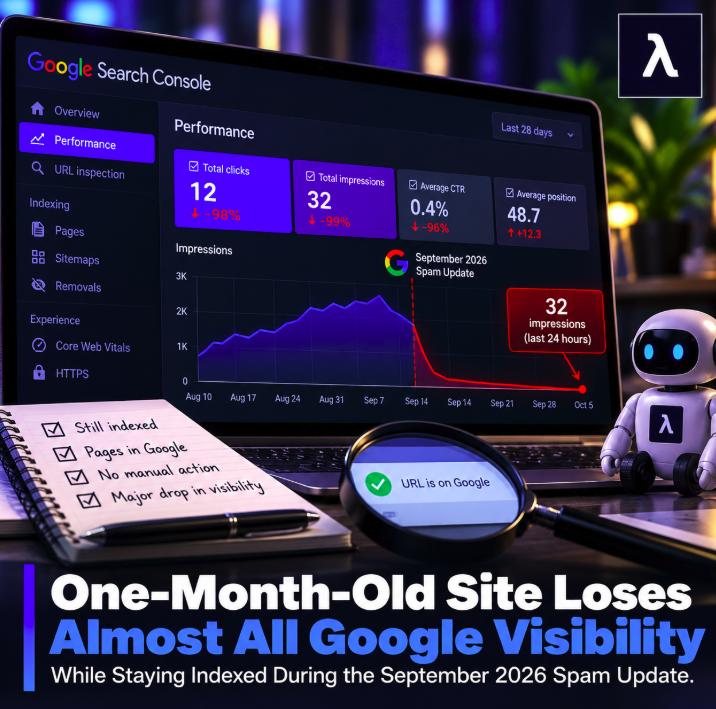
Google's September 2026 spam update is still active, and ranking-monitoring systems have detected another pronounced period of search volatility during the rollout.
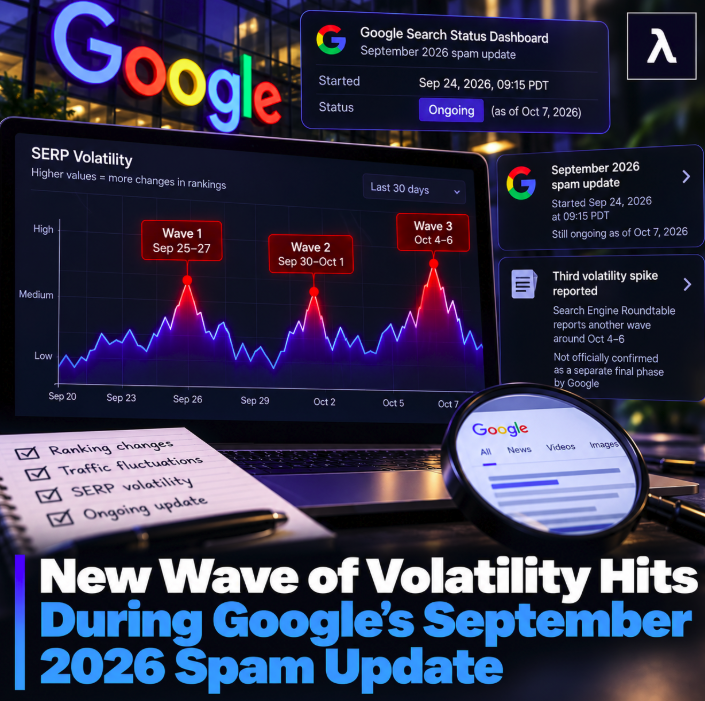
Google's official Search Status Dashboard says the update began on September 24 at 09:15 PDT. As of October 7, Google has not marked the rollout complete.
The latest movement was reported around October 4–6, following earlier periods of volatility around September 25–27 and September 30 into October 1.
The pattern was previously analyzed by NetContentSEO.
Google still lists the spam update as active
The most important confirmed fact is the status of the rollout itself.
Google's Search Status Dashboard continues to list the September 2026 spam update as an active ranking event. The update applies globally and across languages, and Google originally said the rollout could take approximately two weeks.
That makes continued ranking movement in early October consistent with the announced rollout window.
A third burst of volatility appeared around October 4–6
Search Engine Roundtable reported a new acceleration in tracking-tool volatility between October 4 and October 6.
The report aggregated signals from multiple independent monitoring platforms, including AccuRanker, MozCast, Semrush, Similarweb, SISTRIX and Wincher.
These systems use different datasets and methodologies, so they should not be interpreted as direct measurements of Google's internal algorithm. Agreement across several trackers can nevertheless provide useful evidence that rankings are changing more than usual.
The rollout appears to have produced multiple waves
The September update has not behaved like a single moment of ranking disruption.
The first substantial movement was observed around September 25–27, shortly after Google's announcement. Another period of heightened movement followed around September 30 and October 1.
The October 4–6 activity therefore represents at least a third visible period of elevated volatility during the broader rollout.
Google has not officially called these separate phases
It is important to distinguish observation from confirmation.
Google has announced one September 2026 spam update. It has not officially labeled the observed ranking movements as “phase one,” “phase two” or “phase three.”
Those labels are useful analytical shorthand for the timing visible in external tracking data, not official names for separate Google releases.
The update is unusually long compared with other 2026 spam updates
Google's own ranking-update history shows that the March, June and August 2026 spam updates completed in less than three days.
The September update is materially different in duration. Google indicated from the beginning that this rollout could take roughly two weeks, and the status dashboard still shows it active.
A longer rollout creates more opportunities for different groups of sites and queries to experience changes at different times.
Volatility does not reveal what the spam system is targeting
Tracking tools can identify unusual ranking movement, but they cannot explain why an individual URL moved.
Google has not publicly identified a specific new spam tactic targeted by this update. Semrush also notes that Google has not said what the update targets.
That means correlations between a particular SEO practice and a ranking decline should be treated cautiously until stronger evidence emerges.
Sites should be analyzed by date and page type
For research purposes, the multi-wave rollout makes segmentation especially important.
A site that declined on September 26 may have experienced a different timing pattern from one that remained stable until September 30 or October 5.
Researchers should therefore preserve daily Search Console and analytics data, segment performance by directory and page type, and record the first clear date of change rather than simply labeling every September or October decline a “spam update hit.”
Do not confuse volatility with a confirmed penalty
Large ranking changes during an official spam update naturally attract attention, but external volatility data cannot determine whether a specific site violated Google's spam policies.
A decline can overlap an update without proving that the update caused it. Technical changes, indexing problems, competitor movement, demand shifts and unrelated ranking systems can also affect visibility.
The strongest analysis combines update timing with site-level evidence rather than relying on timing alone.
The LMBDA takeaway
The September 2026 spam update provides an unusually useful dataset for studying multi-stage ranking volatility.
Google confirms that one spam update has been running since September 24. External monitoring indicates several distinct bursts of ranking movement inside that rollout window, including another strong period around October 4–6.
What remains unknown is whether those waves represent different components of the spam system, different processing batches, normal propagation through Google's ranking infrastructure or unrelated volatility occurring during the same period.
Until Google marks the rollout complete, the most defensible interpretation is simple: the update is still active, rankings remain unstable, and the apparent “phases” are observations from external data rather than officially confirmed stages.